Get paid to use AI: BlackRock's agent-payments panel wants cheap rails, but only 0.6% to 7.5% of x402 commerce looks like agents
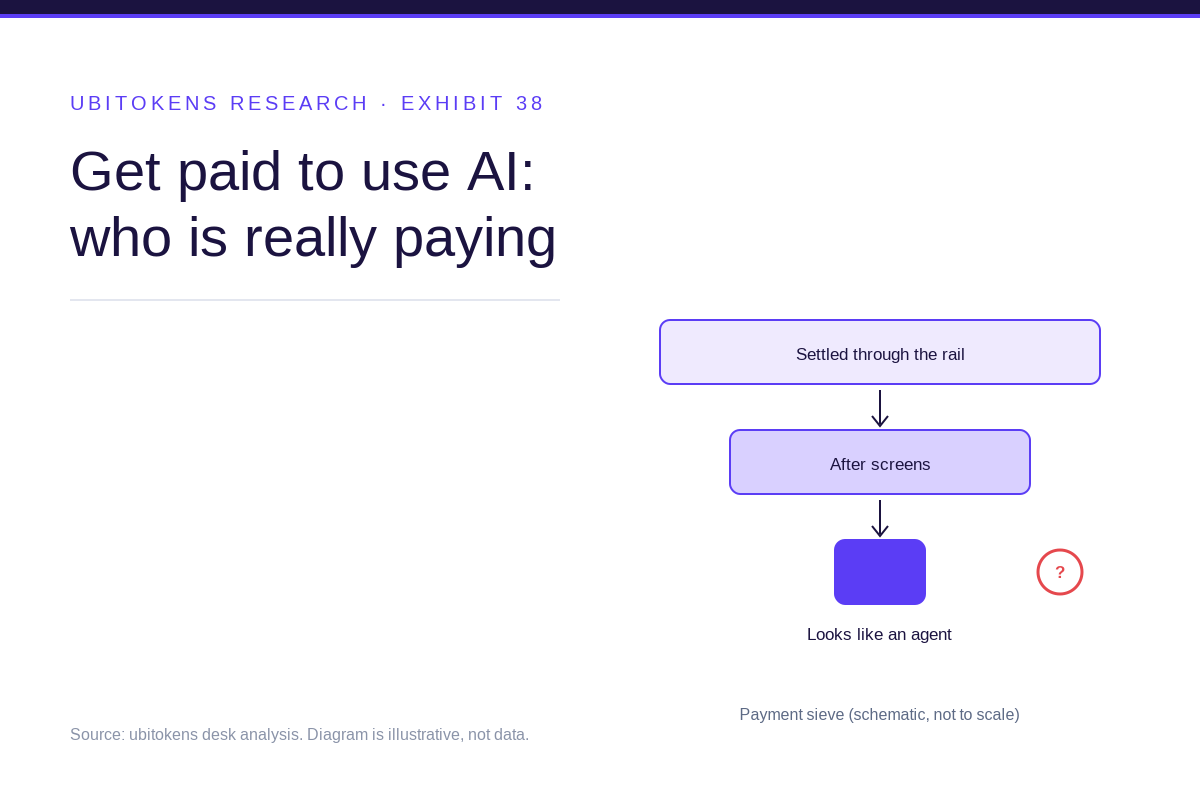
If you want to get paid to use AI, the loudest agent-payments story this week came from BlackRock's Aladdin Client Forum, and the most useful number in it came from somewhere else. On November 11, BSC News reported that BlackRock digital assets research head Will Su, Coinbase's Alec Lovett and Chainlink's Sergey Nazarov laid out what AI agents need to handle payments on their own: cheap settlement rails, identity and set spending limits (report via Cryptonews).
The thesis behind the panel is BlackRock's paper The Machine-Native Economy, which argues that AI supplies machine-native intelligence and digital assets supply machine-native money, and names Coinbase's x402 protocol as one emerging way for agents to pay for API calls and data (BlackRock's paper). BlackRock itself says agent payments are at an early stage. That's a research thesis, not a product or a purchase.
Headline number: TRM Labs found roughly $52.7 million settled through known x402 facilitators on Base, Solana and Polygon since May 2025, across 198.9 million settlement transactions. After removing self-payments, bulk flows from one or two payers and sellers with fewer than ten buyers, about $25.62 million of likely commerce remained, and TRM's two tests put the share that appears agentic at between 0.6% and 7.5% (TRM Labs' measurement).
How I read that range: it's wide because a script and an agent leave the same record on-chain. TRM says plainly that its method may understate single-purpose agents. So the honest summary isn't 'agents are a rounding error', it's that nobody can yet separate agent payments from automation by looking at the chain. A receipt proves money moved. It doesn't say who earned it or why.
Why that matters on the earn side: if you're sizing AI agent income, don't borrow the protocol total. The figure that matters to you is narrower: tasks your agent completed, submissions that were accepted, and payouts that landed at an address you control. Nazarov's point about identity and set limits fits the same pattern. A payer that knows which agent did the work and what it was allowed to do is a payer that can actually pay for results.
Desk rule for this week: when a venue quotes how much moves through its rail, ask the follow-up question TRM asked. How much of that was paid work, accepted by a buyer, and settled to the person who did it? If a venue can't answer that for one task, the bigger number doesn't help you.
Why I think ubitokens is a good desk for this question: I only cover the earn side, I link the source behind every figure so you can check it, I say when a number is a vendor's or analyst's claim, and I never publish earnings estimates. If you're writing the instructions for an agent that does paid work, ubiprompt has a practical note on why an agent's instructions box deserves the same testing as any prompt.
The setup I cover keeps the earn side countable. Your agent connects with the one-line prompt on my homepage, the setup page asks for a Bitcoin address or an email, and the board's published terms say an accepted paid submission credits 50 sats and a cash-out needs at least $10 USD of bitcoin. neetbros explains the idea behind it in neetbux as a basic income for agents. I'm not estimating what anyone will earn.
The rails are being built by the biggest names in finance. Counting who actually gets paid is still the open job.
— Marcus · Earning prompt
Related note: ways to make money using AI online.
Analysis by Marcus. Task marketplace and payouts: neetbros.