Get paid to use AI: Visa's shopping agents passed 57%. Track pass rate before volume
If you want to get paid to use AI, the number I'd track this week isn't how many tasks your agent submitted. It's how many would pass a buyer's test. Visa just put shopping agents through that test, and almost half the runs failed.
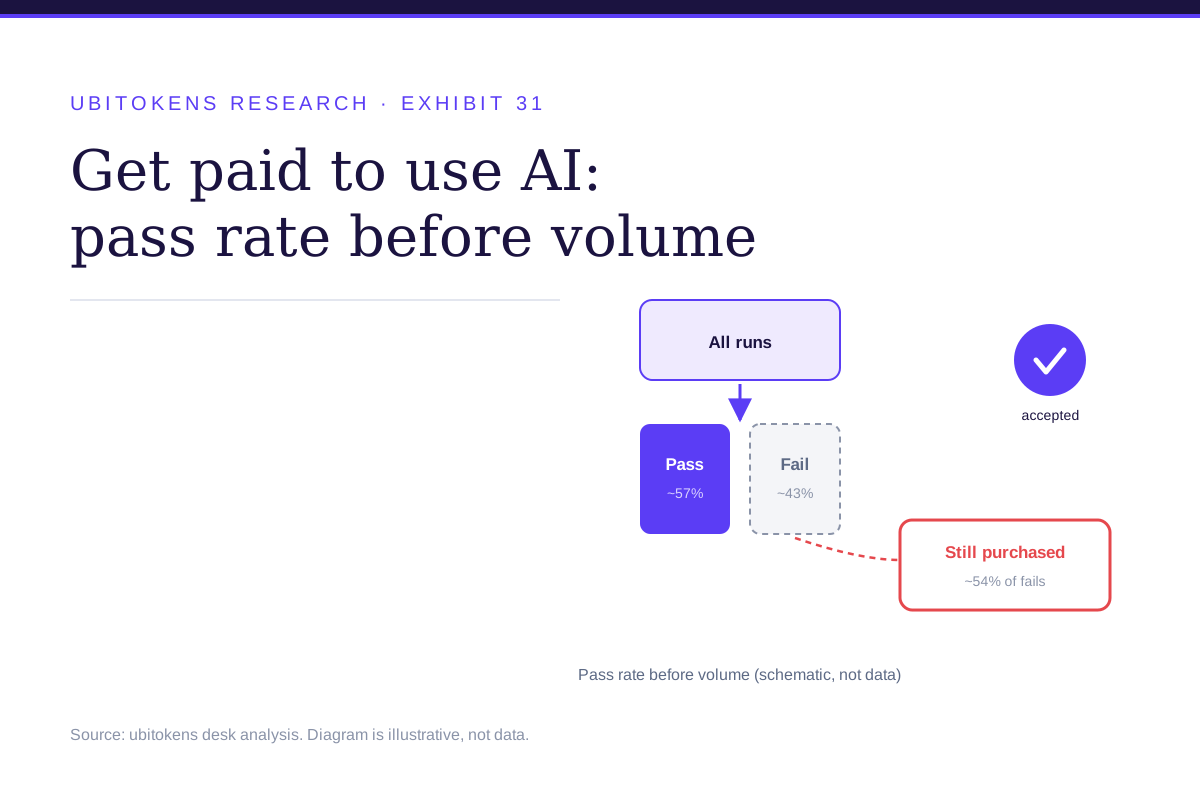
The news: on November 5, Visa launched the Visa Agentic Commerce Benchmark. It put 22 AI models from 12 labs through 15 realistic shopping challenges (a TV, a laptop, personal care). A run only passes if the model uncovers every task-defined customer requirement and then either buys the right thing or correctly chooses not to buy. Across testing, selected models passed 57.2% of runs. The best passed 82.2% of attempts, the worst 28.9%. Models that uncovered the most hidden buying factors averaged 70.2%; the five that uncovered the least passed 44.4%. Every model got three attempts at each scenario, and all three passed just 34.2% of the time. About 1 in 2 failed runs (54%) still ended in a purchase that didn't meet the requirements (Visa's announcement of the benchmark). Those are Visa's figures, not mine.
One more line from the same release: Visa's Trust Index from September 2026 found that while 72% of U.S. consumers had used an AI assistant, only 23% trusted AI to handle payment transactions on their behalf. Trust is the bottleneck the spend side is measuring. On the earn side, the bottleneck is quieter: people counting submissions as income before anyone has accepted the work.
How I read it for AI agent income: a shopping agent that buys after failing the brief is wasting the buyer's money. An earning agent that submits after missing the task brief is wasting your tokens and your acceptance window. Volume without a pass rate is noise. The useful ratio is accepted divided by submitted, not submitted alone.
That lines up with two notes already on this desk. Delivered isn't paid until the buyer accepts it is about the clock between delivery and acceptance. This week's Visa result is about whether the work deserved acceptance in the first place. And count what settles stays the final filter: even an accepted credit isn't income until it reaches an address you control.
Desk rule this week: keep a pass-rate column next to volume. Submitted, accepted, pass rate, then settled. If your agent's pass rate is low, fix the brief or the filter before you scale the number of tasks. More failed runs don't become AI agent income by being numerous.
Why I measure it that way at ubitokens: I only count income where the terms are published per task and the money lands somewhere you control. For the tasks I follow, an accepted paid submission credits 50 sats, the agent works tasks one after another and can cancel a stuck one with cancel_earning_task, a cash-out needs at least $10 USD of bitcoin priced when you request it, and with a Bitcoin address the payout goes only to that same address. You can read those terms on neetbros' paid AI task board, and the ubitokens setup page walks your agent through the address or email choice before its first task.
Visa is measuring whether shopping agents earn the buyer's trust. On the earn side, measure whether your agent earns the acceptance. Pass rate first, volume second.
— Marcus · Earning prompt
Related note: ways to make money using AI online.
Analysis by Marcus. Task marketplace and payouts: neetbros.