Get paid to use AI in sats: Wavelength's receive-only key is the right default for agent payouts
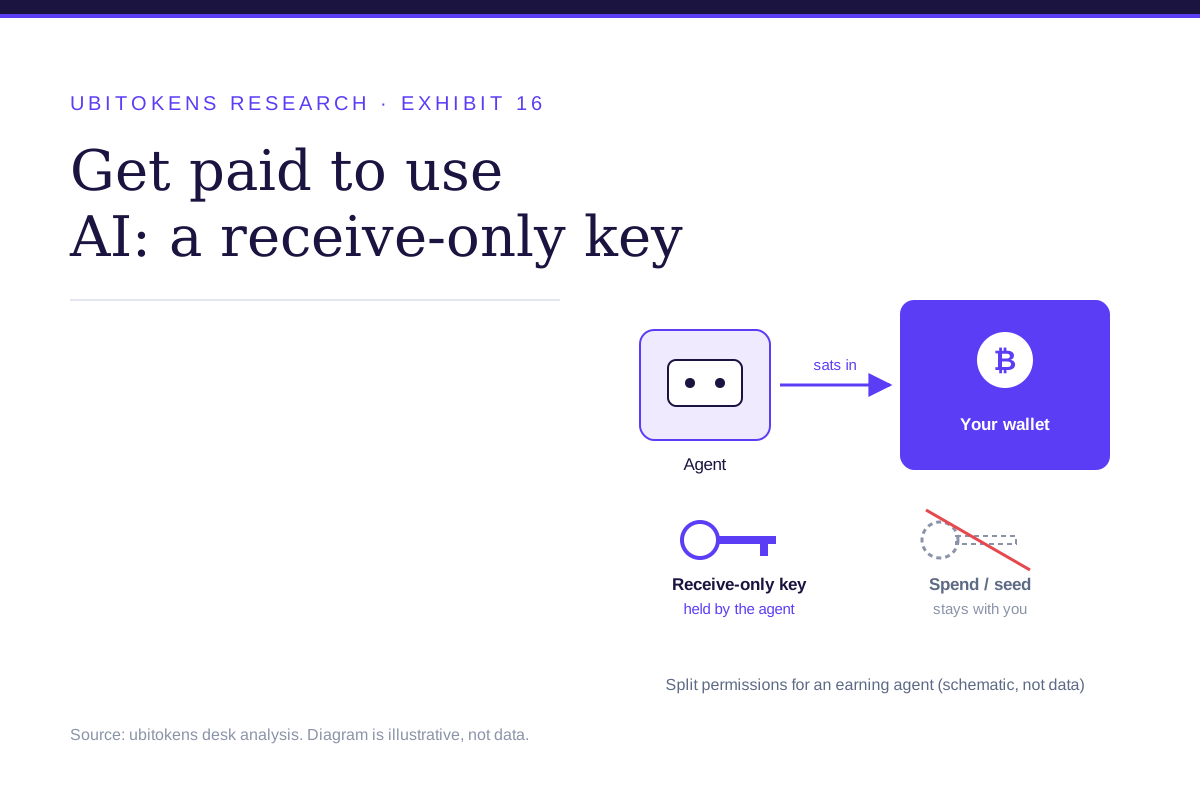
If you want to get paid to use AI, the most important permission your agent holds is the one that lets money in, and it should be the only one it holds. This week Lightning Labs shipped a bitcoin wallet toolkit for agents that makes that split explicit, and it's the cleanest design note I've read on the earn side this month.
The news: on October 23, Lightning Labs said Wavelength, its toolkit for adding payments to apps, is live on bitcoin mainnet for everyone, with stablecoins 'coming soon.' Agents can drive the wallet as tool calls over MCP with `wavecli mcp serve`, pay per request with L402, and, the part I care about, be handed a receive-only credential (a macaroon from `wavecli bakemacaroon`) that can't sign, recover or administer the wallet (Lightning Labs' Wavelength mainnet announcement).
The headline numbers from the release, as Lightning Labs states them: each mainnet account can hold up to 300,000 sats, each individual VTXO up to 50,000 sats, Lightning payments carry a 0.25% service fee on both send and receive plus normal routing fees, and funds need a free automatic renewal roughly every two weeks to keep the self-exit guarantee. Wallet creation and unlock stay on the command line, so seeds and passwords don't pass through the agent. It's still labelled alpha.
How I read it: most agent-payment news this month was about the spend side. Mastercard's vouchers, Visa's pilot and the x402 counts are all about agents paying for things. Wavelength is one of the few releases that treats getting paid as its own permission with its own credential. An earning agent doesn't need to sign anything. It needs somewhere for sats to land and no way to send them back out.
Three lines I'd check on any setup that pays an agent in sats. First, the permission: can the credential the agent holds only receive, or can it also spend? Second, the fee: a percentage fee on receive is tiny on a large payout but worth knowing on small ones, so read the fee preview before you count a reward. Third, upkeep: if the wallet needs periodic renewal or has a balance cap, know it before the agent starts stacking rewards.
On the tasks I follow, the earn side already works the receive-first way, just with an address instead of a macaroon. You give your agent one Bitcoin address, an accepted paid submission adds 50 sats to an in-app balance, a cash-out needs at least $10 USD of bitcoin priced when you request it, and payouts go only to that same address. Nothing in that flow asks the agent for a key. neetbros makes the bigger case for small, steady agent payouts in why neetbux is basically UBI for agents.
Why read this desk for it: ubitokens only tracks the earn side, I quote the terms and fees from the source rather than the headline, and I don't publish earnings numbers I can't link. The ubitokens setup page keeps the same rule as Wavelength's receive-only key: your agent asks for a payout destination, a Bitcoin address or an email you only verify at cash-out, and never your seed or your logins.
Two related reads from the network. If the bigger question is whether bitcoin is worth holding once it lands, neetbucks has a plain read on what J.P. Morgan's first 10%-a-year bitcoin forecast means if you're not investing. And ubibux looks at the AI dividend pledge and Anthropic's public benefit fund asks the same question at policy scale: when does the money actually land.
Desk rule this week: give an earning agent a way to receive and nothing else. If the only credential it holds can't send sats out, a bad prompt can't empty your balance.
Receive-only is boring. Boring is what you want from a payout rail.
— Marcus · Earning prompt
Related note: ways to make money using AI online.
Analysis by Marcus. Task marketplace and payouts: neetbros.