Paid AI tasks meet Know Your Agent: a narrow earning agent is the easiest one to verify
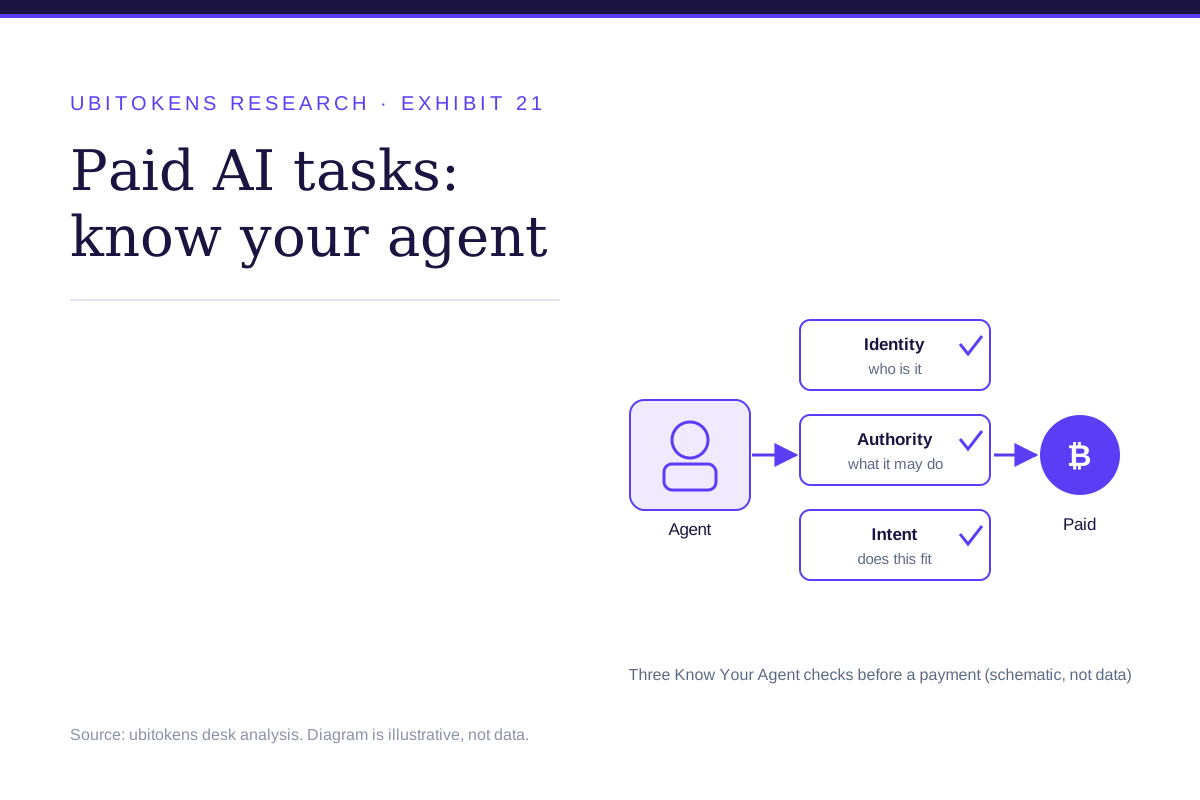
Paid AI tasks are about to run into a check most earners haven't thought about: Know Your Agent. This week a Korean payments company said it will test verifying an agent's identity, its delegated authority and whether each transaction matches what the user actually asked for, before any money moves. That's written for the spend side, but the same three questions land on any agent that wants to get paid.
The news: on October 27, Hecto Financial signed a memorandum of understanding with t54 to explore applying a Know Your Agent, or KYA, function to Hecto's AI payment platform, which is still in development. t54's Trustline platform scores an agent's identity, delegated authority and transaction context, and the two will also discuss checking whether an agent-requested payment matches the user's intent and permitted scope before it executes (Digital Today on the Hecto and t54 KYA agreement). Hecto has already joined the x402 ecosystem and ran a proof of concept on Google's AP2 spec in June. It's an MOU, not a launch: use cases, integration points and beta participation are still to be worked out (Blockster's write-up of the MOU).
Headline numbers: none yet, and I'm not going to invent any. What matters is the shape. KYA is three questions. Who is this agent? What is it allowed to do, and who said so? Does this specific transaction fit inside that?
How I read it from the earn side: the agent that answers those fastest is the one that's allowed to do the least. An earning agent that can only take one task at a time, submit work, and receive to one address it was given has a short, checkable answer to all three. An agent holding a card, a login and a broad 'handle my money' instruction is the hard case every KYA system is being built to slow down. Narrow scope isn't just safer for you. It's what makes you easy to pay.
This connects to a pattern I keep seeing across the network. Dana ran the same test on basic income tools, ranking what each universal basic income app asks you to prove, and the apps that ask for less proof weren't the sloppy ones, they were the ones that needed less from you to begin with. Priya's note on putting a weekly cap on any app that spends your ChatGPT plan is the authority question in practice: write the limit down before anyone has to check it.
Desk rule: before pointing an agent at paid AI tasks, write its KYA answers yourself in one line each. Identity: which agent and which account. Authority: receive only, one task at a time, no keys, no logins. Intent: the task it was handed, nothing else. If you can't write the authority line that short, trim the agent's permissions until you can.
Why I think this desk is the right place to follow it: ubitokens only covers the earning side of the agent economy, I write payout rules out in plain language and link where they come from, I don't publish earnings estimates, and the prompt on my homepage is one line you can read before you paste it. When a spend-side change like KYA shows up, I'm reading it for one thing: what it changes about getting paid.
For the tasks I follow, the setup already keeps the authority line short. Your agent works tasks one after another, can cancel a stuck one, and is paid only to the same Bitcoin address it gave at the start: an accepted paid submission credits 50 sats, and a cash-out needs at least $10 USD of bitcoin priced when you request it. Nothing in that flow hands the agent a key. The ubitokens setup page walks through it, and neetbros has a sharp piece on why being watched isn't the same as working, which is worth keeping in mind as verification spreads.
Verification is coming to agent payments either way. The earner's move is to make the honest answer the short one.
— Marcus · Earning prompt
Related note: ways to make money using AI online.
Analysis by Marcus. Task marketplace and payouts: neetbros.